Mario Merz
Past exhibition
Overview
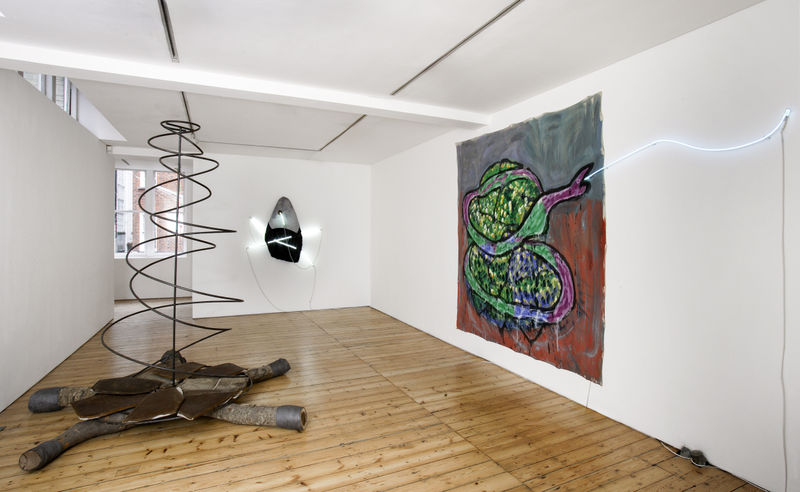
Mario Merz was a leading member of the Italian artistic movement known as Arte Povera. Merz and his colleagues, who included his wife Marisa, Giovanni Anselmo, Luciano Fabro, Jannis Kounellis, Michelangelo Pistoletto, used ordinary, "poor" materials, both natural and manufactured, to create the most poetic, extraordinary effects. Their work gained international prominence in the late 1960s and, together with Futurism,remains one of the most influential movements of Italian art in the 20th century.
In the highly charged atmosphere of the 1960s - while Alberto Burri was burning pieces of plastic, and Piero Manzoni was canning his own excrement - Merz also moved away from painting.
Amid the political turbulence of 1968 he seized upon an archetypal form - the igloo - that could symbolize his own opposition to consumer capitalism. With this new motif he was able to present a variety of complementary themes: the lost purity of pre-industrial societies; the constantly changing, nomadic identity of modern man and his own powers of imaginative association.A seminal work from 1967 is also in the exhibition and is made from his own raincoat juxtaposed with neon lights.
He later reclaimed painting adding to it glowing neon figures, penetrating the picture surface, marking the prehistoric animals which inhabit it with their unrestrained, primeval power.
Merz’s entire work is based on the idea of expansion that occurs in the form of a spiral. The spiral is the dynamic structure that best corresponds to biological expansion in Nature- a type of expansion that has not yet been subjected to the anti- biological, suppressive act to be shaped into form. The dynamically expanding spiral also derives from another main evocative concept that Mario Merz made his own: the Fibonacci sequence, defined by Abbot Leonardo da Pisa at the start of the 13thcentury, within which every number is generated by the sum of the two preceding ones (1, 1, 2, 3, 5, 8, 13,…). This numeric progression was used by Merz to describe the law of Nature and to represent the expansion in space of an object.
Centrality to all his work is the melting between organic and inorganic. His message was about the energy of life and through his work he confirms and celebrates the ephemeral nature of the natural phenomena.
Installation Views

